
“Beloved, do not believe every spirit, but test the spirits to see whether they are from God, for many false prophets have gone out into the world.” – 1 John 4:1
Sometime ago, after writing a blog post about a specific groups of false teachers, a reader asked me how they could identify a false teacher? It’s a valid question since the whole idea of false teaching is that of deception. A false teacher can be difficult to identify because there is always some amount of truth mixed in with many lies. After all, every predator uses bait to distract their prey from seeing danger. This habit is no different from that of the devil’s. 2 Corinthians 11:13–15 says, “For such men are false apostles, deceitful workmen, disguising themselves as apostles of Christ. And no wonder, for even Satan disguises himself as an angel of light. So it is no surprise if his servants, also, disguise themselves as servants of righteousness. Their end will correspond to their deeds.” Paul explains that false teachers are servants of Satan and, like Satan, they deceive mankind from hearing the truth of the gospel by disguising themselves as trustworthy teachers of the Bible, (Matt. 24:24). Because false teachers are servants of Satan they must be identified and rebuked, not only for our own sakes but also for the salvation of others. But how can one know if somebody is a false teacher or not? It might seem impossible since they use the Bible in their teaching, however it’s not complicated when one understands what the Bible describes as false teaching and why Christians should be aware of false teachings.
What is False Teaching?
The 2017 Ligonier National Conference called The Next 500 Years celebrated the five-hundredth anniversary of the Protestant Reformation and to consider the future of the church. In one panel discussion, R.C. Sproul, John MacArthur, and Al Mohler discuss the topic of “How do you define a false teacher?” As these men go back and forth in the discussion, MacArthur observes, “I think we need to say that there are some absolutely non-negotiable truths that you are false to teach: if you deny the Trinity, if you deny the deity of Christ, if you deny His sinless life and substitutionary death, salvation by grace through faith, the gospel. That’s the drivetrain of truth, saving truth. Those are no-negotiable.”1
False teaching can be defined as any non-negotiable doctrine that deviates from the Bible’s teaching. In Colossians 1:24-2:23, Paul strives to help the believers in Colossae see Christ’s preeminence over all things, including the false teachers. His goal is to ensure that believers are mature in their faith by knowing the truth of Christ and being grounded in it. Doctrines of the Bible can be most easily categorized in a theological triage. Like in medicine, a triage is the process of prioritizing something due to importance. A theological triage is the process of prioritizing doctrines to distinguish their importance, usually to determine if one can do ministry with others. Below is a diagram explaining the 3 tiers of the theological triage.
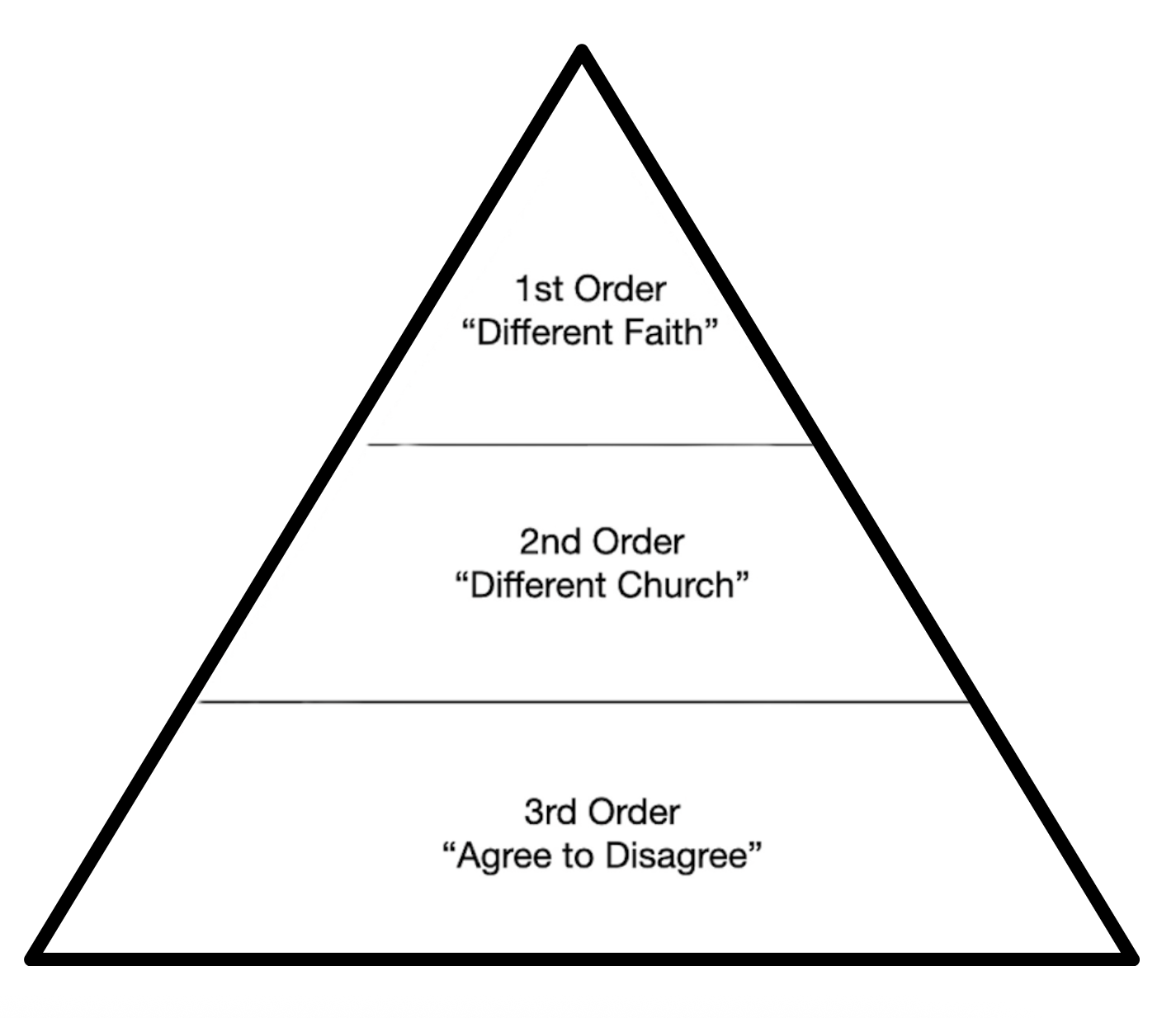
- First Order – these are the non-negotiables that MacAurther was talking about earlier. These are issues that pertain to God Himself and the gospel of Jesus Christ. These doctrines include but are not limited to the Trinity, the deity of Christ, the sinlessness of Christ, the substitutionary death of Christ, and salvation by grace alone through faith alone.
- Second Order – these are the commonly held beliefs and convictions of a local body of believers. These doctrines mostly include, but are not limited to ecclesiology, (type of church government), preaching styles, music preferences, etc.
- Third Order – these are the non-essentials of the faith. These doctrines include, but are not limited to views on the end times, Reformed Theology, parenting, marriage (complementarianism /egalitarianism), etc.
For the purposes of this post in identifying false teachers, we will be focusing on what teachings one must hold to in order to be considered a trustworthy teacher of the Bible, which is the First Order of importance. Disagreeing with First Order doctrines means one is of a different faith.2 A false teacher teaches in opposition to the first order of the theological triage and is therefore not a true believer in Christ.3
In Colossians 2:6-23, the church in Colossae was facing heavy false teaching. Paul encouraged this congregation to remain grounded in the truth so that they will know when false teachers come around spreading their lies. Paul loves these people and does not want to see them led astray. Paul teaches them three non-negotiables of the Christian faith in which to root themselves, in order they might not be deceived. They are:
- The Hypostatic Union of Christ (vs. 9) – the belief in the union of two different natures in Jesus’ incarnation; one fully divine nature and one fully human nature (but not a sinful nature). This is what make Jesus able to die for us – He is our representative as a fellow-human.
- The Believer’s Union with Christ (vs. 10-13) – the belief that a regenerated Christian’s old life of sin has died with Jesus and he has been raised to a new and holy life in Christ.
- The Penal Substitutionary Death of Christ (vs. 14) – the belief that Jesus took the full punishment of our sin that was reserved for every believer and removed all guilt associated with it.4
To deny any parts of the above doctrines means that one is a victim of false teaching. Teaching the denial of any part of these doctrines means that one is a false teacher. After all, that’s what the phrase false teacher means; one who teaches falsehood.
There are many worldviews and religious institutions that deny different aspects of the doctrines, making them false religions that if followed will lead one astray from Christ and salvation. Even some “Christian” denominations will agree with some variation of these doctrines, but the falsehood is where they deviate from the Bible. Roman Catholicism, Islam, Judaism, Mormons (Latter-Day Saints), Jehovah’s Witnesses, The New Apostolic Reformation, Bethel Church in Redding, CA, and many more all do not hold to these doctrines accurately or at all. They are all false teachers. But there are three other non-negotiables of the Christian faith that we see in the Bible and most of the groups mentioned above reject the following doctrines to some extent as well:
- The sinlessness of Christ (2 Corinthians 5:21, Hebrews 4:15) – the moral and spiritual perfection of Jesus Christ and the fact that He is the only person to walk the earth who did not do anything wrong.
- The Trinity (Genesis 1:26, Hebrews 1:3) – God existing as three person in one God as explained in the Athanasian Creed.
- Salvation by faith through Grace (Romans 10:9, Ephesians 2:1-9) – the belief that man is too sinfully corrupt to contribute anything to his salvation, therefore can do nothing to earn it. God alone is the one who saves a person on the basis on someone’s faith, not by any works.
The point of this is, when we look in the Bible where God speaks about false teachers, we see one main theme: false teaching denies the Gospel of Jesus Christ. They might deny it all together, (like Muslims), or they might deny different parts of the gospel of Jesus Christ, putting their own spin on it, (like Catholics, Mormons, Jehovah’s Witnesses, Bethel Church, etc.). Either way, false teachers can be identified as those who teach anything that denies any part of the Gospel of Jesus Christ.
2 Corinthians 11:13–15 says, “For such men are false apostles, deceitful workmen, disguising themselves as apostles of Christ. And no wonder, for even Satan disguises himself as an angel of light. So it is no surprise if his servants, also, disguise themselves as servants of righteousness. Their end will correspond to their deeds.” Paul reveals that false teachers are servants to Satan and, like Satan, they deceive mankind from hearing the truth of the gospel by disguising themselves as Christian teachers of the Bible. So what do we do? Paul urges the believers at Colossae as well as you and I to be rooted in Him with overwhelming gratitude to God in Christ for transferring us from the domain of darkness into the kingdom of light. We need to be mature in our faith, so we too will be able to resist false teachers when we hear their lies. Many people think of false teachers as the Pharisees or some ancient cult that no longer exists. And this is true, but false teachers are still around today. In fact, they are all around us. People teach against the gospel of Jesus Christ everyday here in America and around the world. This is why knowing what false teaching is and being able to identify it is so vitally important. So, reader, know and understand the gospel of Jesus Christ fully. Not only will your faith deepen and love for your savior, but you will be much better equipped to identify a false teacher.
- https://www.youtube.com/watch?v=_EuYOj7nxq8 ↩︎
- Disagreements with the Second Order doctrines are not views of a different faith, but are components of a different Christian denomination or a different local church body. Disagreements with Third Order doctrines means you can be fellow church members, but disagree on minor topics. ↩︎
- Dr. Al Mohler clarified this point in the Ligonier Conference video mentioned. He stated that a false teacher is “one who teaches falsely, but who is uncorrectable, who resists correction.” Not a believer who teaches falsely out of ignorance and then corrects himself later on – that is not a false teacher. This person is one who does not change his false teachings when confronted by the Scriptures. ↩︎
- For a fuller explanation on these doctrines being discussed, refer to Wayne Grudem’s book Systematic Theology. ↩︎
 Christian Perspectives